Last updated: October 2026
Background and Basic Idea
Stepped wedge cluster randomized trials (SW-CRTs) are increasingly adopted for comparative effectiveness and implementation science research. In a SW-CRT, all clusters start under the control condition and cross over to the intervention at randomly assigned, staggered time points. While around 30 to 40 SW-CRT protocols are published each year, the analysis of these trials has relied almost exclusively on mixed-effects models or generalized estimating equations (GEE), with the treatment effect read off as a single regression coefficient. Because the multilevel and longitudinal structure allows different analytic decisions to answer different questions, this convention leaves open a fundamental question, namely “what exactly is being estimated, and for whom?”, especially when the model is imperfectly specified. Meanwhile, in our review of SW-CRTs published in 2016-2022, more than 70% adjusted for baseline covariates in the primary analysis, despite limited guidance on how to do so without changing the question being answered. This webpage summarizes our team’s work on causal inference methods for SW-CRTs (supported in large part by a PCORI Methodology Award; see the acknowledgement below), under the philosophy that “estimands drive the statistical analysis of SW-CRTs, but not the other way around.” The development is largely based on the potential outcomes framework and follows two principles. The analysis should be estimand-aligned, in that the estimand is defined first and without reference to any regression model, and the estimator remains valid for that estimand even when the working model is incorrect. The analysis should also be efficiency-focused, in that baseline covariates are leveraged to improve precision, which is essential given the limited number of clusters in a typical SW-CRT. The central finding is that, when cluster-period sizes are variable and informative (i.e., the treatment effect varies with the cluster-period size), there is no longer a single “treatment effect” in a SW-CRT, and the target of inference depends on two choices:
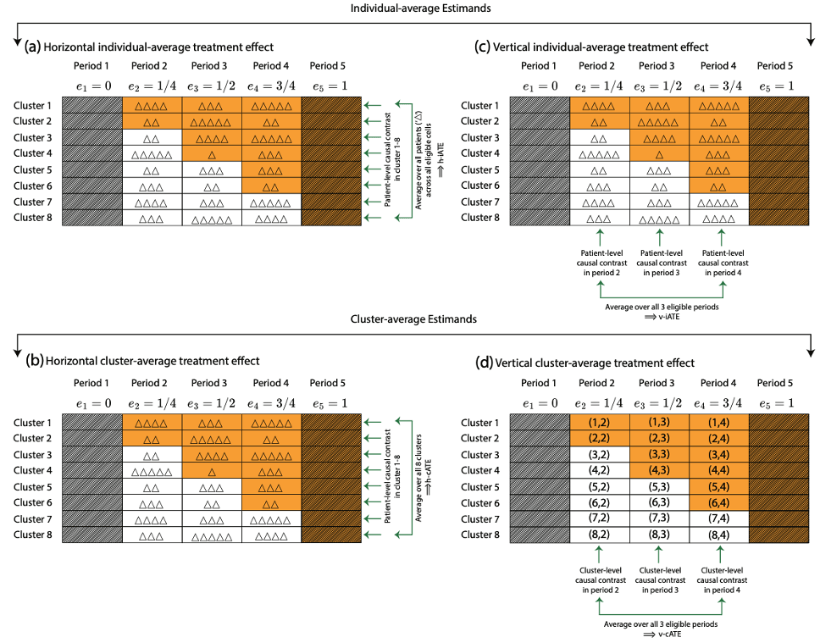
- Unit of inference (individual-average versus cluster-average): whether each individual or each cluster receives equal weight in the average; this is the distinction already familiar from the estimands literature for parallel-arm CRTs;
- Direction of aggregation (horizontal versus vertical): whether outcomes are pooled across periods before taking the contrast (horizontal), or each period is treated as a mini-CRT and the period-specific effects are then averaged with equal weight (vertical); this is the less familiar dimension that is unique to the multi-period structure of SW-CRTs.
Crossing these two choices leads to four estimands: the horizontal individual-average treatment effect (h-iATE), the horizontal cluster-average treatment effect (h-cATE), the vertical individual-average treatment effect (v-iATE), and the vertical cluster-average treatment effect (v-cATE). All four are defined over the rollout periods where both treated and control clusters are present, because the all-control first period and the all-treated last period carry no randomized contrast. The four estimands coincide when cluster-period sizes are non-informative, but can differ markedly otherwise.
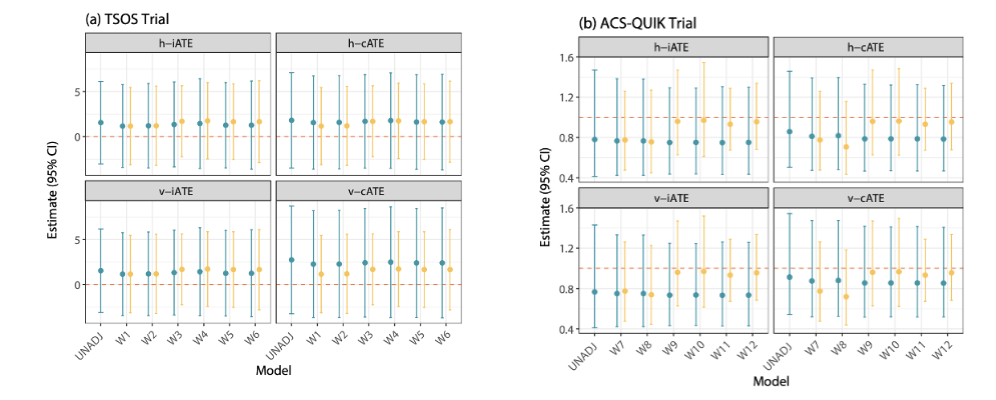
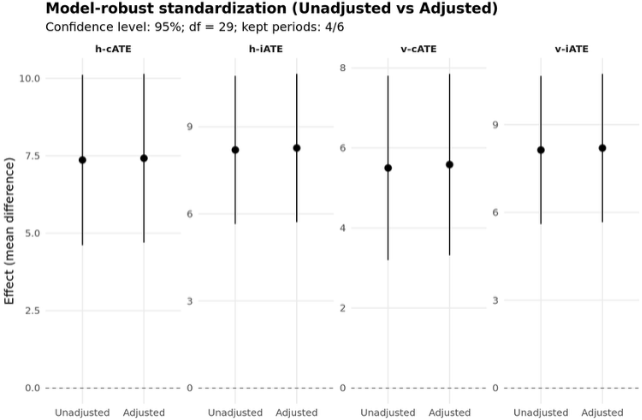
The procedure involves the following steps: (1) Pre-specify the estimand that matches the scientific question, before choosing any model; (2) Fit a familiar working outcome model with pre-specified baseline covariates, such as a linear mixed model, a generalized linear mixed model, or GEE; (3) Apply model-robust standardization to convert the fitted working model into an estimand-aligned effect estimate, with a leave-one-cluster-out jackknife variance estimator for inference; (4) Compare estimates across the four estimands as a check on informative cluster-period sizes. In our simulations and reanalyses, the treatment coefficient from the working model can be noticeably biased for these estimands under informative sizes (sometimes more so with richer random-effects structures), whereas the model-robust standardization estimator remains nearly unbiased with close to nominal coverage regardless of the working model, and is more efficient than the unadjusted nonparametric estimator. To support implementation, an R package (MRStdLCRT, available on CRAN) and annotated R source code (swcrtcov, for model-assisted ANCOVA estimators) have been developed by our team, and all software, code and case-study tutorials are centralized on a dedicated GitHub page. At this stage, MRStdLCRT covers continuous and binary outcomes (on the mean difference, risk difference, risk ratio or odds ratio scale) and builds on the assumption that the treatment effect does not depend on the duration of exposure, which is arguably the most common working assumption in practice. The swcrtcov code is currently released as annotated source code rather than a formal package. Extensions to dynamic, anticipation, and multiple-intervention settings are addressed in separate publications listed below.
Publications and Software
We have developed a collection of new estimands, estimators and theoretical results for defining and estimating average causal effects in SW-CRTs, addressing different aspects of complications encountered in statistical practice. These publications include:
- A plain-language primer on the stepped wedge design for a clinical audience: Li F, Wang B, Heagerty PJ. What is a stepped wedge cluster randomized trial? JAMA Internal Medicine. 2025; 185(5):593-94.
- When can familiar model-based methods still deliver model-robust inference: Wang B, Wang X, Li F. How to achieve model-robust inference in stepped wedge trials with model-based methods? Biometrics. 2024; 80(4):ujae123.
- Prototypical development of model-assisted ANCOVA estimators that remain valid under arbitrary working model misspecification: Chen X, Li F. Model-assisted analysis of covariance estimators for stepped wedge cluster randomized experiments. Scandinavian Journal of Statistics. 2025; 52(1):416-46. [swcrtcov source code and tutorial]
- Four estimands and a one-stop shop model-robust standardization approach that works with any working model: Fang X, Wang X, Heagerty PJ, Wang B, Li F. Model-robust standardization in stepped wedge cluster randomized trials. Journal of the Royal Statistical Society: Series A. 2026; qnag056. [R package MRStdLCRT]
- Protecting mixed model inference when the random-effects structure is misspecified: Ouyang Y, Taljaard M, Forbes AB, Li F. Maintaining the validity of inference from linear mixed models in stepped-wedge cluster randomized trials under misspecified random-effects structures. Statistical Methods in Medical Research. 2024; 33(9):1497-516.
The estimands above assume that the intervention takes full effect once rolled out. Given that this may not hold in many pragmatic SW-CRTs, our team has also studied causal effects that vary with exposure time, arise before rollout, or involve more than one intervention. These publications include:
- How to define and estimate dynamic causal effects under staggered rollout: Chen X, Li F. Model-assisted inference for dynamic causal effects in staggered rollout cluster-randomized experiments. arXiv preprint. arXiv:2502.10939. 2025+ (under invited revision)
- What if clusters respond to the intervention before it is rolled out: Wang H, Chen X, Courtright K, Halpern S, Harhay MO, Taljaard M, Li F. On anticipation effect in stepped wedge cluster randomized trials. Statistics in Medicine. 2026; 45(3-5):e70380.
- Time-varying treatment effects when more than one intervention is rolled out: Chen Z, Wang W, Lu Y, Halpern S, Courtright KR, Li F, Harhay MO. Time-varying treatment effect models in stepped-wedge cluster-randomized trials with multiple interventions. Statistics in Medicine. 2026; 45(13-14):e70625. [Annotated R code]
Given that the estimand questions in SW-CRTs are rooted in those for simpler cluster randomized designs, our team has also provided a set of foundational results on estimands and model-robust covariate adjustment in parallel-arm cluster randomized trials and cluster randomized crossover trials (CRXO trials), which served as building blocks for the stepped wedge developments. These publications include:
- Demystifying individual-average and cluster-average estimands: Kahan BC, Blette B, Harhay M, Halpern S, Jairath V, Copas A, Li F. Demystifying estimands in cluster randomised trials. Statistical Methods in Medical Research. 2024; 33(7):1211-32.
- Efficient covariate adjustment that does not rely on a correct model: Wang B, Park C, Small DS, Li F. Model-robust and efficient covariate adjustment for cluster-randomized experiments. Journal of the American Statistical Association. 2024; 119(548):2959-71.
- Model-robust standardization as a general recipe in parallel-arm CRTs: Li F, Tong J, Fang X, Cheng C, Kahan BC, Wang B. Model-robust standardization in cluster-randomized trials. Statistics in Medicine. 2025; 44(20-22):e70270.
- Estimands and doubly robust estimators when the outcome is time-to-event: Fang X, Wang B, Hu L, Li F. Estimands and doubly robust estimation for cluster-randomized trials with survival outcomes. Statistics in Medicine. 2026; 45(6-7):e70457.
- What do common estimators target in parallel-arm CRTs with a baseline period: Lee KM, Li F. How should parallel cluster randomized trials with a baseline period be analyzed?—A survey of estimands and common estimators. Biometrical Journal. 2025; 67(3):e70052.
- What do common estimators target in CRXO trials with informative sizes: Lee KM, Forbes AB, Kasza J, Copas A, Kahan BC, Young PJ, Harhay MO, Li F. What is estimated in cluster randomized crossover trials with informative sizes?—A survey of estimands and common estimators. Statistical Methods in Medical Research. 2026; 35(9):1980-2000.
- Model-robust analysis when outcomes and covariates are incomplete: Wang B, Li F, Wang R. Handling incomplete outcomes and covariates in cluster-randomized trials: doubly-robust estimation, efficiency considerations, and sensitivity analysis. Biometrics. 2026; 82(1):ujag030.
- Flexible covariate adjustment when the design uses rerandomization: Wang B, Li F. Asymptotic inference with flexible covariate adjustment under rerandomization and stratified rerandomization. Journal of the Royal Statistical Society Series B: Statistical Methodology. 2026; qkag117.
- Estimating equations for complex correlation structures: Chen T, Li F, Wang R. Network generalized estimating equations for complexly correlated data with applications to cluster randomized trials. Biostatistics. 2025; 26(1):kxaf039.
In companion, our team contributed to a community-wide effort to bring the estimands framework into the practice of cluster randomized trials, culminating in the consensus-based CRT-Estimands Framework as an extension of the ICH E9(R1) addendum. These publications include:
- The consensus statement: Kahan BC, Bretz F, Copas A, Harhay MO, Collins GS, Bahti M, Bi D, Campbell M, Courtright KR, Feeney T, Forbes A, Garg AX, Halpern SD, Heagerty PJ, Hemming K, Hopewell S, Hughes J, Murray DM, Ross JS, Stewart D, Taljaard M, Ukoumunne O, Auriemma CL, Li F. The CRT-Estimands Framework: A consensus-based extension of the ICH E9(R1) addendum for cluster randomised trials. BMJ. 2026; 393:e089050.
- A concise summary of the framework for a clinical audience: Kahan BC, Collins GS, Bretz F, Li F. The CRT-Estimands framework for cluster randomized trials. JAMA. 2026; 336(2):101-2.
- The Delphi study behind the consensus: Kahan BC, Bahti M, Bi D, Bretz F, Collins GS, Copas A, Harhay MO, Li F, Auriemma CL. Development of a consensus extension of the estimands framework for cluster randomised trials (CRT-estimands): results from an international Delphi study. Trials. 2026; 27(1):70.
- A scoping review that informed the framework: Bi D, Copas A, Li F, Kahan BC. A scoping review identified additional considerations for defining estimands in cluster randomised trials. Journal of Clinical Epidemiology. 2026; 189:112015.
- A perspective on the role of estimands in CRTs: Hooper R, Hemming K, Li F. The wood and the trees: Estimands in cluster randomised trials. Trials. 2026; 27(1):312.
- An empirical example where the choice of estimand changes the interpretation: Bi D, Copas A, Li F, Harhay MO, Kahan BC. Choice of estimands and estimators affected the interpretation of results for some outcomes in a cluster randomised trial (RESTORE) due to informative cluster size. Journal of Clinical Epidemiology. 2026; 199:112462.
Finally, a credible causal analysis starts from an efficient design. For planning SW-CRTs, we have contributed sample size methods that leverage a baseline measurement of the outcome, optimal and cost-efficient design selection, and systematic reviews of current practice. These publications include:
- How much power is gained by using a baseline measurement of the outcome: Davis-Plourde K, Goldfeld K, Allore H, Taljaard M, Li F. Designing stepped wedge cluster randomized trials with a baseline measurement of the outcome. Statistics in Medicine. 2025; 44(20-22):e70273. [R Shiny App SWCRTbaseline]
- Optimal designs when the analysis uses GEE: Liu J, Li F. Optimal designs using generalized estimating equations in cluster randomized crossover and stepped wedge trials. Statistical Methods in Medical Research. 2024; 33(8):1299-330.
- Parallel-arm, crossover or stepped wedge, which design to choose: Liu J, Li F, Sutcliffe S, Colditz GA. Selecting the optimal longitudinal cluster randomized design with a continuous outcome: parallel-arm, crossover, or stepped-wedge. Statistical Methods in Medical Research. 2025; 34(10):2069-90.
- Optimal designs under open-cohort sampling: Liu J, Li F, Luo X, Chen L, Ramsey A. Optimal designs in open-cohort longitudinal cluster randomized trials with a continuous outcome. Biometrical Journal. 2026; 68(3):e70138.
- Design selection when cost matters: Liu J, Li F. Cost-efficient design selection for stepped-wedge, basic staircase, and cluster randomized crossover trials. Statistics in Medicine. 2026+ (under invited revision)
- A careful look at the mixed-model ANCOVA: Wang B, Harhay MO, Tong J, Small D, Morris T, Li F. On the mixed-model analysis of covariance in cluster-randomized trials. Statistical Science. 2026; 41(1):49-68.
- How well do published SW-CRTs adhere to key design and analysis recommendations: Nevins P, Ryan M, Davis-Plourde K, Ouyang Y, Macedo JP, Meng C, Tong G, Wang X, Ortiz-Reyes L, Caille A, Li F, Taljaard M. Adherence to key recommendations for design and analysis of stepped-wedge cluster randomized trials: A review of trials published 2016-2022. Clinical Trials. 2024; 21(2):199-210.
- Current practice in SW-CRTs with very few clusters: Tong G, Nevins P, Ryan M, Davis-Plourde K, Ouyang Y, Macedo JP, Meng C, Wang X, Caille A, Li F, Taljaard M. A review of current practice in the design and analysis of extremely small stepped-wedge cluster randomized trials. Clinical Trials. 2025; 22(1):45-56.
Beyond the average causal effects, for subgroup causal effects, the study team is continuing to explore calibrated Bayesian methods with mixed-effects Bayesian Additive Regression Trees (BART), and the current developments in this area are:
- How are subgroup analyses conducted and reported in SW-CRTs: Tong G, Li C, Wang H, Fang X, Liu R, Zeng Y, Sun Q, Ouyang Y, Baumann MR, Davis-Plourde K, Wang Z, Li F, Taljaard M. Subgroup analyses in stepped-wedge cluster randomized trials: A systematic review of statistical practice and reporting from 2016 to 2023. Journal of Clinical Epidemiology. 2026; 200:112512.
- Calibrating Bayesian posterior inference for cluster randomized trials: Liu R, Warren JL, Ohnishi Y, Spiegelman D, Hu L, Li F. Calibrated Bayes analysis of cluster-randomized trials. Statistics in Medicine. 2026; 45(25-27):e70797.
- Calibrated Bayesian inference for overall and subgroup effects in SW-CRTs: Liu R, Ohnishi Y, Fang X, Daniels MJ, Li F. Calibrated Bayesian inference for overall and subgroup-specific causal effects in stepped-wedge cluster-randomized trials. arXiv preprint. arXiv:2610.20858. 2026. [Annotated R code and tutorial for mixed-effects BART]
To illustrate these methods in the context of real studies, we reanalyzed recently completed pragmatic SW-CRTs with data shared by our stakeholder partners, including the Trauma Survivors Outcomes and Support (TSOS) trial, the Randomized Evaluation of Default Access to Palliative Services (REDAPS) trial, the Lumbar Imaging with Reporting of Epidemiology (LIRE) trial, and the Prognosticating Outcomes and Nudging Decisions in the Electronic Health Record (PONDER) trial. The case-study tutorials walk a reader from study design (SWCRTbaseline Shiny app), through model-assisted and model-robust analysis (MRStdLCRT package and swcrtcov code), to flexible Bayesian subgroup analysis (mixed-effects BART), and are all available on the project GitHub page.
Primary Investigator Team
- Principal Investigator: Fan Li, PhD, Associate Professor, Department of Biostatistics, Yale School of Public Health
- Co-Investigator: Patrick Heagerty, PhD, Professor, Department of Biostatistics, University of Washington
- Co-Investigator: Liangyuan Hu, PhD, Associate Professor, Department of Biostatistics and Epidemiology, Rutgers University
- Co-Investigator: Michael Harhay, PhD, Associate Professor, Department of Biostatistics, Epidemiology and Informatics, University of Pennsylvania
Disclaimer and Acknowledgement
The research summarized on this webpage was supported in large part by a competitive Patient-Centered Outcomes Research Institute (PCORI) Award ME-2022C2-27676, “Toward Improved Design and Analysis of Stepped Wedge Trials: An Estimand-aligned and Efficiency-focused Framework”. The official PCORI webpage can be found here, where one can also locate the peer-reviewed version of the Final Research Report once it is online (forthcoming). All members of the study team expressed sincere gratitude to PCORI for supporting this work and making it possible, thereby enabling the development of this new strand of methodological research. To our knowledge, this work represents the first effort to bring estimands and model-robust causal inference into the stepped wedge cluster randomized trials.
The Investigator Team would also like to express their deep gratitude to all collaborators and stakeholder partners who have contributed their expertise and dedication throughout this award, including Drs. Jeffrey Jarvik (PI of the LIRE trial), Douglas Zatzick (PI of the TSOS trial), Scott Halpern and Katherine Courtright (PIs of the PONDER-ICU and REDAPS trials), Thomas Travison, and Monica Taljaard (members of the Design and Statistics Core at the NIA IMPACT Collaboratory). It has been a genuine privilege to work with such an engaged and interdisciplinary team. The stakeholder discussions, together with the continued feedback from the Biostatistics and Study Design Core of the NIH Pragmatic Trials Collaboratory and the Design and Statistics Core of the NIA IMPACT Collaboratory, have profoundly shaped the direction of this research and have motivated ideas that extended well beyond the initial proposal. We are truly thankful for their partnership.
Disclaimer: The statements in this website are solely the responsibility of the authors and study team and do not necessarily represent the views of PCORI, its Board of Governors, or Methodology Committee. The principal investigator Fan Li extends special thanks to Hao Wang and Yukang Zeng for their valuable assistance in developing the initial version of this webpage.

